
EQUALSEQUEL board game
Can you follow on?
Can you make everything balance?
EQUIPMENT
The game is played on a Scrabble board and
uses the rack. You will need a set of 100 wooden number tiles from the
Trimming Shop (on Ebay).
Divide the tiles into numbers, operators and =
tiles.
Equations are read from left to right, and
from top to bottom.
Use the / tiles as if they were = tiles: use a
permanent black marker to draw a = sign on the back of the ten /
tiles.
Fill your rack with five unseen numbers and
two operators: +, -, x and divide. No looking.
THE BASIC GAME
At the beginning of your turn, draw an equals
sign and then make a play using the tiles on your rack, e.g. 3 x
5 = 14 + 1. Each side of the equation must balance.
The first player should play across the
central square of the board, which is a double word score.
The second player’s tiles should touch
those of the first player, either by using an existing tile, or
by lying alongside. However, be careful not to commit INEQUALITY
by putting tiles on the board in a way that 'breaks' the rules of
maths. (see * below). That would be INIQUITY. Severe penalties
follow.
Other players should be alert for an instance
of INEQUALITY, but should only announce it when the player has
finished their turn properly.
If you don’t use your equal sign in your
turn, because you have played across an existing equal sign, you
may add it to your rack making a total of eight tiles. No rack
may ever contain more than eight tiles. No rack may contain more
than one = equal tile. You can play two equals signs in a later
turn if you wish, or retain the equal sign you have earned for an
extra go at the end of the round.
At the end of your play, refill your rack to
five number tiles and two operators.
Equations with a negative value are not
allowed (but see advanced play below).
ORDER OF PLAY
This progresses at each turn, e.g. in a four
player game, play is, turn one ABCD, turn two BCDA, turn three
CDAB etc.
The game ends when all twenty = tiles have
been played.
HINTS
Only whole numbers are allowed in the game: e.g.
16 divided by 4 is allowed, but 15 divided by four is not.
Inexperienced players of the game should be allowed to exchange
the divide operator if they draw one, also known as share, as
this is the hardest operator to play. Be generous to
inexperienced players, by allowing them to choose operators for
example.
More than one equal sign is allowed, e.g. 3 x
3 = 9 = 7 + 2. This is a DOUBLE equation. Score the whole line
when adding to it.
6 and 9 tiles can be played either way up.
Note that adding a zero before a number is
allowed, e.g 09. This can generate a big score.
The round ends when all twenty = signs have
been played.
SPECIAL PLAY
SLITHER
If the board has e.g. 84 = 84, you may slide
one or more of the tiles to the side when adding others, to make
e.g. 284 = 284. SLITHER can only be played in single equations.
SWIVEL
You may rotate the sixes on the board to make
nines, or vice versa, when playing your turn, but be sure that
you don’t commit INEQUALITY by doing so.
SCORING
Add up the value of the tiles you have played,
taking account of the double and triple letter and double and
triple word squares. The zero tile scores aero points or ten
points at the player’s choice.
Performing SLITHER gets a bonus of 20.
Performing SWIVEL gets a bonus of 20.
Playing all five of your numbers in a turn, as
in the first example above, gets a double bonus of 40 or wins
double word, whichever you choose.
Double and triple letter and word squares are
scored only once, when first covered, except when spaces are
revealed briefly during SLITHER.
LEG-UP
The player who has the lowest score in a round
receives a first LEG-UP of 10 points. Don’t lose heart. You
may get a good turn next time. Note your streak of LEGs-UP, as
the score for LEG-UP doubles each time - 10, 20, 40, 80 etc. This
only applies to LEGs-UP in a continuous row. Don't attempt to
claim a larger LEG-UP following a broken leg.
Penalty for INEQUALITY
Score zero, and return all your tiles to the
pool. Receive no LEG-UP as you do not qualify. Draw again next
time.
ADVANCED PLAY
Try some alternate games, for example
ALL AGAINST THE BOARD
Play with just one rack, visible to all
players. Set a timer for everyone to decide the best score they
can make and then share your answers. The player who achieves the
highest score wins.
LOWEST SCORE wins.
Bonuses and LEG-UPs reduce your score rather
than raising it. LEG-UP streaks do not double as the LEG-UP has
become a LEG-DOWN. Each operator used gives a reduction of five
points
NEGATIVE play.
Allow equations that add up to less than zero
e.g -7 +2 = -5. Remember that minus times minus equals plus, e.g.
-7 x -7 = 49.
LOW START
Mix operators and numbers together. Each
player starts with three tiles. Draw an extra tile on your turn,
and choose whether to play or not. Only draw = tiles when needed.
You may draw up to three in a turn. Game ends when all = tiles
are used.
Think of your own adaptation of the game, for
example, try playing a game with more operators or more numbers
or both.
Feedback and ideas for improvement welcome.
Thank you.
-oOo-
* Footnote
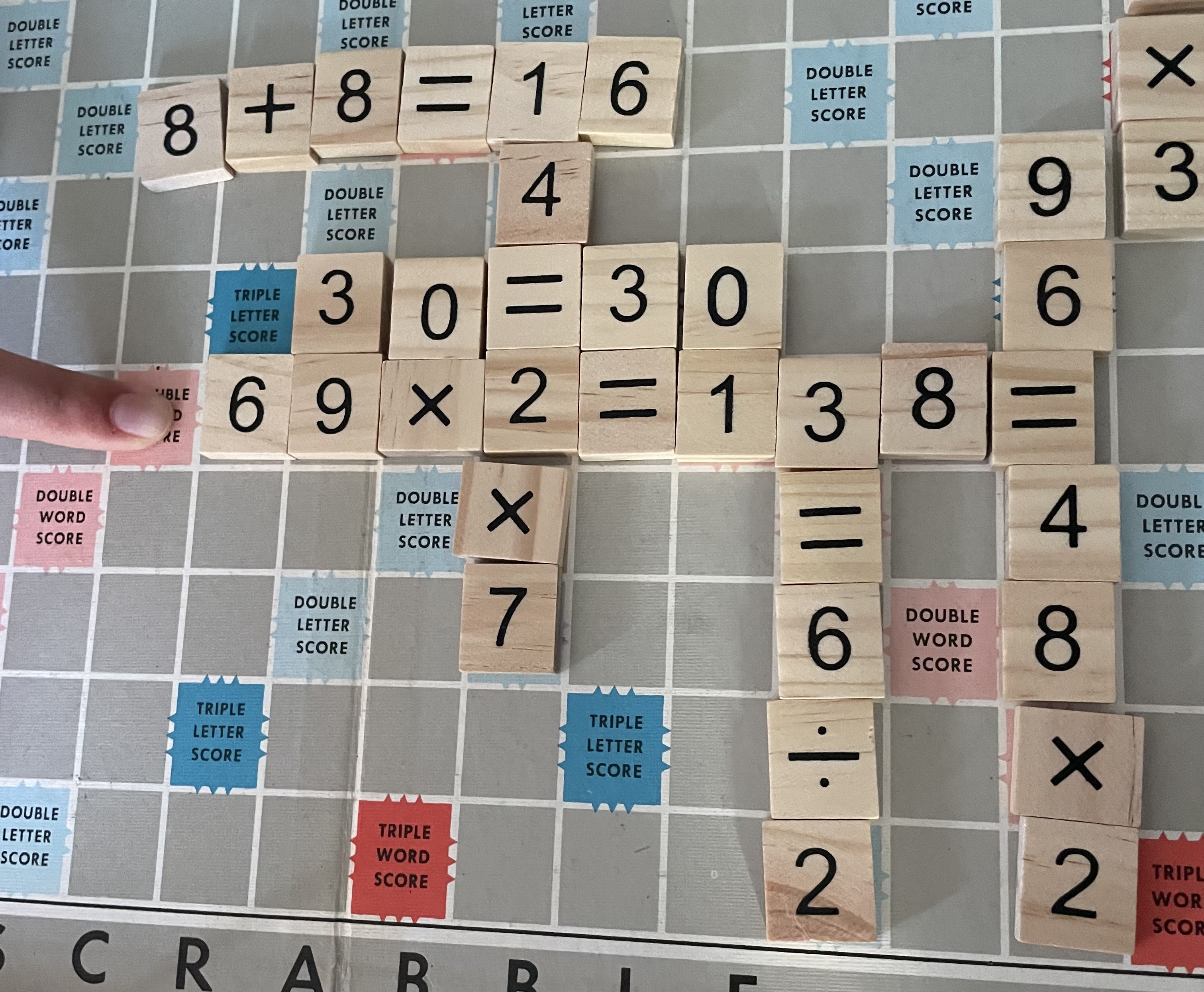
My play of 69 x 2 = 138 shown by my finger
does not quite commit INEQUALITY, so it was allowed, even though
0X was sailing close to the wind. I scored 58. I was pleased with
it. The following turn to its right by Joshua of 96 = 48 x 2
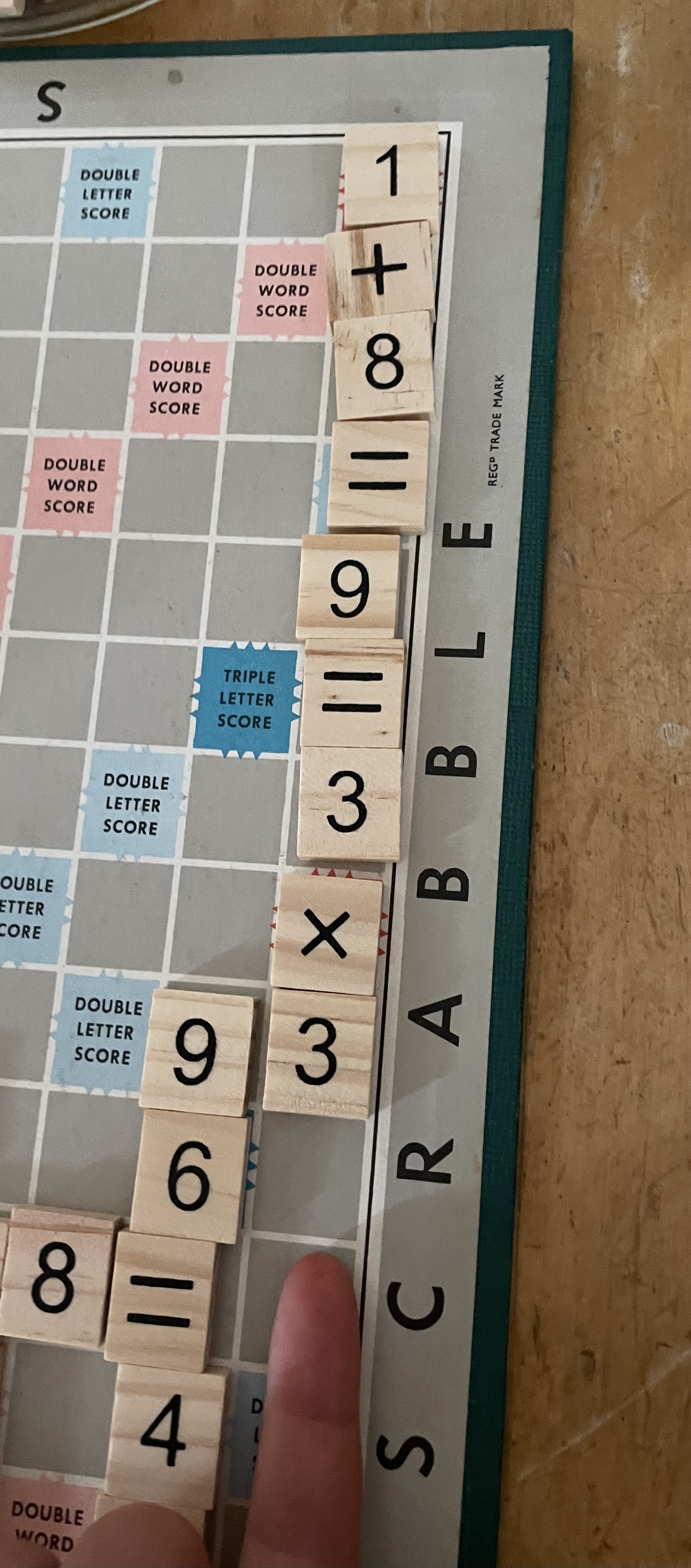
scored 82. Impressive. The next turn by Oliver 1 + 8 = 9 = 3 x 3
(see below) stretched across two triple word scores and scored a
massive 216. Astonishing. Note his use of two = signs. I was
helpfully humbled, although I did receive a ten point LEG-UP as a
consolation prize.
Can anybody beat Oliver's total for one word?
Have fun
Woking