
Six Degrees:
Our Future on a Hotter
Planet
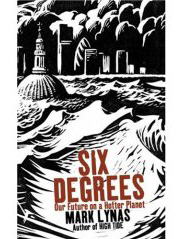
Mark has spent many weeks
and months in the John Radcliffe
Science Library in Oxford, reading
thousands of recent journal articles and books about global
warming. He has arranged his findings in six chapters, entitled 1
Degree, 2 Degrees, etc, followed by a conclusion.
The book describes itself
as popular science. Everything is made clear to the non-specialist,
but I did not feel talked down to. Although the contents are
alarming, they are not alarmist. I found the book most
informative.
Even with only one degree
of warming, the prospects are grim reading. For example, America
is likely to have a recurrence of its Dust
Bowl problem of 1934 - 1940 (p8-9).
Arctic ice melt gets worse; "between December 2004 and
December 2005... an astonishing 14 percent of the Arctic Ocean's
perennial sea vanished (720,000 square kilometres, the size of
Texas, p33)."
Despite severe problems,
"two degrees of global warming is likely to be survivable
for the majority of humanity (p99)." But three degrees looks
likely to trigger an acceleration in global warming due to Carbon cycle feedback
(p126-128). Put simply, instead of absorbing Carbon Dioxide, the
world's soils would start releasing it instead through heightened
bacteria action. Millions of people suffering drought and famine
in the tropics and subtropics are likely to migrate north into
Europe and North America. With even greater warming, the Sahara
desert will spread north of the Med, and everybody will be
landing up in the UK! Five degrees of warming will lead to
billions of lives being lost, but six degrees could wipe out
humanity altogether (p230).
These quotations are just
the tip of the iceberg. We need to take action, folks. This is
not a time for our traditional approach of too little too late.